
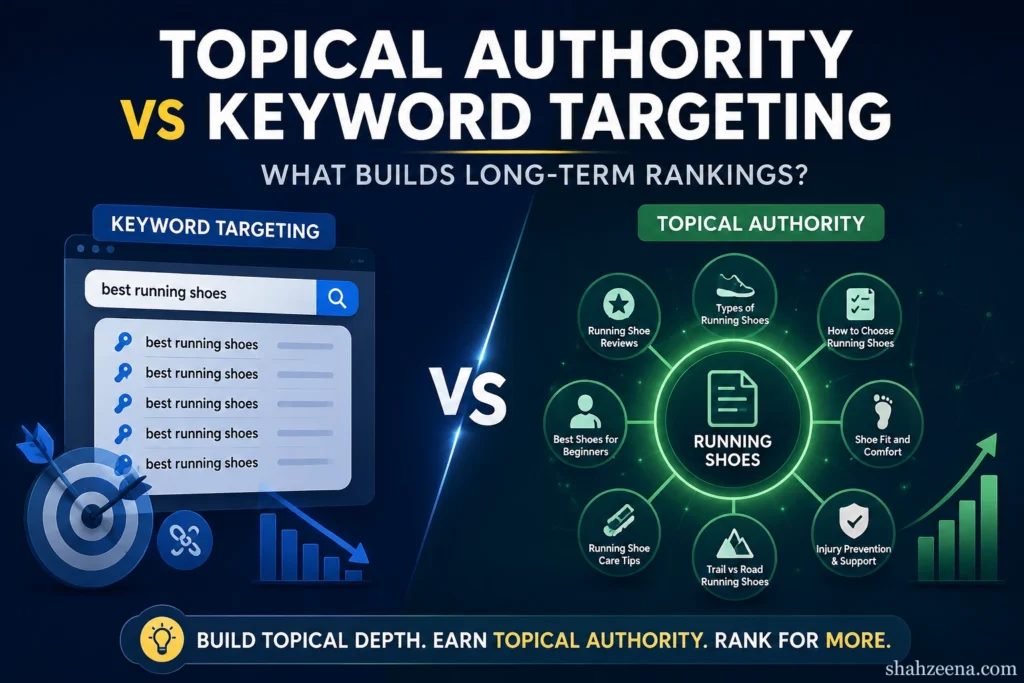
For years, SEO strategies were heavily focused on one goal: ranking individual keywords.
Publish a page targeting a phrase, optimize headings, add the keyword several times, and try to rank. That approach still exists, but modern search engines evaluate content differently than they did a decade ago.
Today, websites that consistently perform well in organic search usually do more than target isolated keywords. They build topical relevance across entire subject areas.
This is where the debate between topical authority and keyword targeting becomes important.
The question is no longer just:
“Can this page rank for a keyword?”
It is increasingly:
“Does this website demonstrate expertise and depth around the topic itself?”
Understanding the difference can completely change how content strategies are planned, scaled, and maintained over time.
Why This SEO Debate Matters More Than Ever
Search engines have become better at understanding:
- Search intent
- Semantic relationships
- Entities and concepts
- Contextual relevance
- Topic depth across websites
A page can still rank for a keyword without strong topical authority, especially for low-competition queries. But sustainable visibility across dozens or hundreds of related searches usually requires broader topical coverage.
This shift matters because many websites still rely on disconnected keyword lists instead of building structured content ecosystems.
As a result, they often experience:
- Inconsistent Rankings
- Traffic Volatility
- Keyword Cannibalization
- Thin Topical Coverage
- Weak Internal Linking
- Poor Long-Term Growth
Meanwhile, sites with strong topical structures tend to build compounding SEO value over time.
What Is Keyword Targeting in SEO?
Keyword targeting is the process of optimizing a page around a specific search query.
Examples include:
- “Best Seo Tools”
- “Technical Seo Checklist”
- “Ai Seo Prompts”
Traditional SEO workflows often follow this structure:
- Find keywords with search volume
- Create one page per keyword
- Optimize titles and headings
- Add internal links
- Attempt to rank the page individually
This approach is still useful in many scenarios.
Where Keyword Targeting Still Helps
Keyword targeting works well for:
- Landing Pages
- Local Seo Pages
- Product Pages
- Transactional Search Intent
- High-Conversion Service Pages
- Focused Informational Content
A page optimized around a clear intent can still perform very well when the topic scope is narrow.
Limitations of Isolated Keyword Strategies
The problem starts when SEO becomes only a keyword collection exercise.
Many websites publish dozens of disconnected articles that:
- Overlap In Intent
- Repeat Similar Information
- Compete Against Each Other
- Lack Semantic Relationships
- Fail To Support Broader Expertise Signals
This creates fragmented SEO architecture.
A website may rank temporarily for individual phrases but struggle to build long-term topical trust.
What Is Topical Authority?
Topical authority refers to how comprehensively and consistently a website covers a subject area.
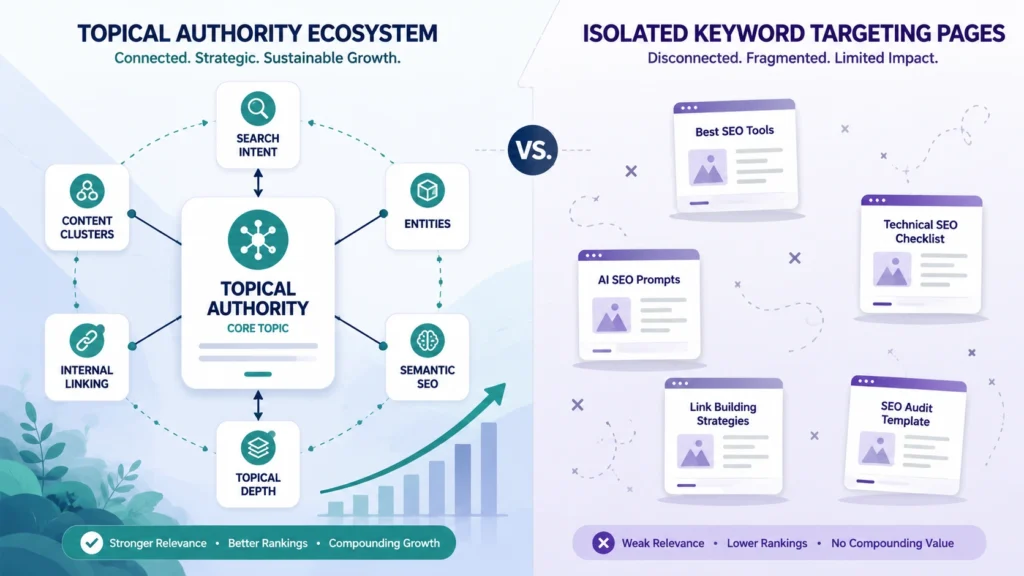
Instead of publishing isolated pages, the site builds a connected ecosystem of content around a core topic.
For example, a website focused on semantic SEO might cover:
- Topical Maps
- Entities
- Internal Linking
- Search Intent
- Content Clusters
- Semantic Relationships
- Information Gain
- Seo Site Architecture
- Topical Depth
These pages reinforce each other contextually.
Search engines can then better understand:
- What The Site Specializes In
- How Pages Relate To Each Other
- Whether The Site Demonstrates Expertise On The Subject
How Search Engines Evaluate Topical Depth
Search engines do not rely on exact-match keywords alone.
They also analyze:
- Related Terminology
- Contextual Phrases
- Semantic Associations
- Internal Linking Patterns
- Entity Relationships
- User Satisfaction Signals
A website that consistently covers related subtopics sends stronger relevance signals than a site publishing unrelated content around random keywords.
The Role of Semantic Relationships and Entities
Modern SEO increasingly depends on contextual understanding.
Search engines connect concepts such as:
- Semantic Seo
- Entities
- Topical Maps
- Content Clusters
- Search Intent
- Information Architecture
These relationships help algorithms understand topical breadth and expertise.
Why Topical Clusters Improve Relevance
Topic clusters create structural clarity.
A strong cluster typically includes:
- A Core Pillar Page
- Supporting Subtopic Pages
- Internal Contextual Links
- Intent-Specific Content Layers
This improves:
- Crawlability
- Topical Reinforcement
- User Navigation
- Content Discoverability
- Semantic Relevance
Topical Authority vs Keyword Targeting: The Core Difference
The main difference is strategic depth.
| Keyword Targeting | Topical Authority |
| Focuses on individual keywords | Focuses on subject ecosystems |
| Optimizes single pages | Builds connected topic clusters |
| Often volume-driven | Often intent and relevance-driven |
| Can create fragmented content | Creates contextual relationships |
| Short-term ranking focus | Long-term visibility focus |
| Easier to scale quickly | Requires planning and structure |
Keyword targeting asks:
“How do we rank this page?”
Topical authority asks:
“How do we become a trusted source on this subject?”
Both approaches matter, but they solve different SEO problems.
Why Keyword Lists Alone Often Fail Today
Thin Coverage Problems
A single article rarely satisfies every related intent around a complex topic.
Without supporting content, pages may lack contextual depth.
Cannibalization Risks
Publishing many similar keyword-focused articles can lead to overlapping intent.
Examples include:
- “Topical Authority Seo”
- “Topical Seo Strategy”
- “Semantic Topical Authority”
- “How Topical Authority Works”
If these pages target nearly identical intent, they may compete against each other.
Intent Mismatch Issues
Search engines evaluate whether content actually satisfies the reason behind a query.
Ranking difficulty increases when pages:
- Answer The Wrong Intent
- Provide Shallow Explanations
- Ignore Supporting Context
- Fail To Connect Related Concepts
How Topical Authority Improves Long-Term SEO Performance
Internal Linking Advantages
Strong topical structures naturally improve internal linking.
Relevant contextual links help search engines:
- Discover Pages Faster
- Understand Page Relationships
- Distribute Authority Signals
- Interpret Topical Hierarchy
For example, a broader SEO learning hub can support related semantic SEO articles naturally.
You can also strengthen supporting workflows with practical resources like SEO tools and templates.
Semantic Reinforcement
When multiple pages consistently discuss related concepts, they reinforce overall topical relevance.
This helps search engines connect your site with broader thematic expertise.
Improved Crawl Understanding
Clear topic architecture helps crawlers understand:
- Site Structure
- Content Hierarchy
- Subject Specialization
- Contextual Relationships
Disconnected pages make this harder.
Better Trust and Expertise Signals
Websites that cover a subject comprehensively often appear more trustworthy to users because they answer connected questions instead of isolated ones.
This improves:
- Session Depth
- Navigation Flow
- Return Visits
- Content Discoverability
When Keyword Targeting Still Matters
Topical authority does not replace keyword optimization completely.
Keyword targeting still matters for:
Transactional Pages
Commercial pages usually need focused optimization around conversion intent.
Local SEO
Location-specific searches often require direct keyword relevance.
High-Conversion Landing Pages
Specific service pages may perform best with narrow keyword alignment.
The strongest SEO strategies combine both approaches instead of treating them as opposites.
How To Build Topical Authority Without Publishing Random Content
Many websites misunderstand topical authority and publish endless low-quality content.
That usually creates clutter instead of authority.
A better approach is structured topical planning.
AI-assisted keyword extraction workflows can help identify semantic relationships and supporting subtopics more efficiently when building stronger topical clusters.
Start With a Core Topic
Choose a clear subject area relevant to your expertise.
Examples:
- Semantic Seo
- Ai Seo Workflows
- Technical Seo
- Local Seo
Create Supporting Clusters
Map related subtopics around the main subject.
Each supporting article should solve a distinct user problem.
Map Search Intent
Different pages should address different intent layers:
- Beginner education
- Comparisons
- Frameworks
- Implementation
- Tools
- Troubleshooting
Strengthen Internal Links
Internal links should connect contextually related pages naturally.
A strong content ecosystem works better than isolated posts.
To understand how clusters, keywords, and search intent connect strategically, start with this complete SEO strategy guide.
Update Content Regularly
Topical authority is maintained over time.
Refreshing content helps maintain relevance as search behavior changes.
Common Mistakes That Prevent Topical Authority
Common SEO problems include:
- Publishing duplicate intent articles
- Ignoring internal linking
- Focusing only on search volume
- Creating shallow AI-generated pages
- Weak site architecture
- Inconsistent topical focus
- Missing entity coverage
- Disconnected content planning
Authority is not built by volume alone.
It is built through relevance, clarity, usefulness, and structure.
A Simple Framework for Combining Both Strategies
The most effective SEO systems usually combine:
- Keyword research
- Topical clustering
- Semantic relationships
- Search intent mapping
- Structured internal linking
- Content quality improvements
Instead of choosing one side entirely, use keyword targeting inside a broader topical framework.
This creates a more scalable and sustainable SEO strategy.
If you are building long-term SEO systems instead of isolated blog posts, explore the broader SEO strategist and trainer resources.
FAQ
Topical authority and keyword targeting serve different purposes. Keywords help optimize individual pages, while topical authority helps search engines understand broader expertise across a subject area.
Yes. A new website can build topical authority by focusing on a clear niche, publishing high-quality supporting content, and creating strong internal linking structures.
Strong topical coverage can improve search visibility because it helps search engines understand semantic relationships and subject expertise more clearly.
Content clusters are a structural method used to build topical authority. Topical authority is the broader outcome of comprehensive, connected topic coverage.
Most SEO articles should still align with a primary search intent or keyword theme, but they should also support broader topical relevance instead of existing in isolation.
Final Thoughts
Keyword targeting still plays an important role in SEO, but isolated keyword strategies are becoming less reliable for long-term growth.
Search engines increasingly evaluate:
- Topical depth
- Semantic relevance
- Internal relationships
- Intent satisfaction
- Subject expertise
Websites that organize content into meaningful topical ecosystems are often better positioned to build sustainable organic visibility.
The goal is no longer just ranking a page.
It is becoming a trusted source for the entire topic.


