AI tools changed how SEO teams approach research, topic discovery, and content planning. A task that once required hours of manual analysis can now be completed in minutes with AI-assisted keyword extraction tools.
But speed created a new problem.
Many websites now publish content built from large AI-generated keyword lists without understanding search intent, topical relevance, or user expectations. The result is thin content that repeats phrases without actually helping readers.
Search engines have become much better at identifying content that exists only to manipulate rankings. Pages overloaded with extracted keywords but lacking clarity, originality, and depth often struggle to maintain visibility over time.
The smarter approach is to use AI keyword extraction as a research assistant rather than a publishing strategy.
This guide explains how to use AI for keyword extraction while maintaining semantic depth, topical authority, and people-first content quality.
What Is AI Keyword Extraction?
AI keyword extraction is the process of using artificial intelligence systems to identify important words, phrases, entities, and contextual patterns from content, search queries, or datasets.
Modern AI systems can detect:
- Recurring Phrases
- Semantic Relationships
- Nlp Keywords
- Topic Clusters
- Contextual Entities
- Search Intent Modifiers
- Related Questions
Unlike traditional keyword research tools that focus heavily on volume metrics, AI-based systems often analyze contextual meaning and relationships between concepts.
For example, a page about AI SEO research may also naturally connect with:
- Semantic Keyword Extraction
- Topical Authority
- Search Intent Analysis
- Entity Optimization
- Nlp Processing
- Content Gap Analysis
This is important because modern search engines evaluate topical understanding instead of counting exact-match keywords alone.
Why Thin Content Happens With AI SEO Workflows
AI itself is not the problem. Weak workflows are.
Thin content usually appears when writers treat extracted keywords as instructions instead of signals.
Over-optimization
Some AI tools generate hundreds of related phrases. Publishing content that forces all of them into headings and paragraphs creates unnatural pages.
Readers notice it quickly.
Search engines do too.
Repetitive NLP Phrases
Many AI-generated articles repeat nearly identical terms because the workflow prioritizes extraction quantity instead of topical usefulness.
Examples include:
- Repeating “Best Ai Seo Tool”
- Excessive Semantic Duplication
- Unnatural Keyword Variation Stuffing
Semantic relevance should improve clarity, not reduce readability.
Lack of User Intent Understanding
Keyword extraction alone cannot explain why people search.
A query may indicate:
- Informational Intent
- Commercial Investigation
- Comparison Research
- Transactional Intent
- Troubleshooting Needs
Without intent mapping, extracted keywords become disconnected from actual user expectations.
Ignoring Entities and Context
Search engines increasingly rely on entity relationships and contextual understanding.
A strong article about AI keyword extraction may naturally include entities such as:
- Nlp
- Semantic Seo
- Search Intent
- Topic Clusters
- Internal Linking
- Content Optimization Workflows
Thin pages usually ignore these relationships entirely.
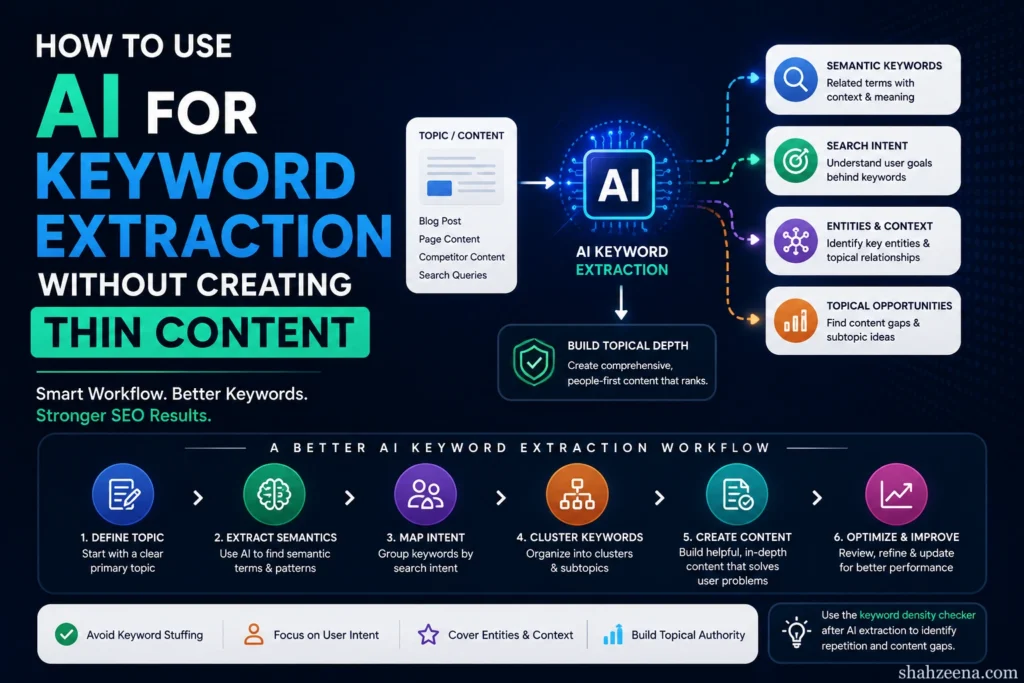
A Better AI Keyword Extraction Workflow
A useful workflow focuses on topic depth instead of keyword accumulation.
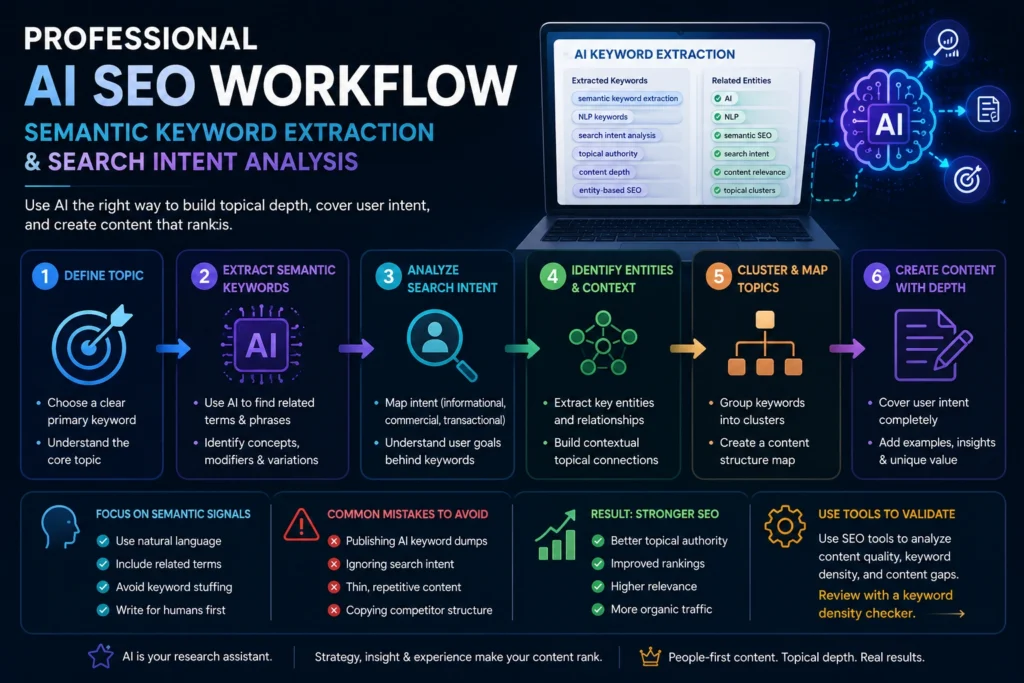
Step 1: Start With One Primary Topic
Choose one clear primary keyword.
For this article, the core topic is:
AI keyword extraction
Everything else should support that topic instead of competing with it.
Step 2: Extract Semantic Relationships
Use AI tools to identify:
- Related Concepts
- Recurring Contextual Terms
- Subtopics
- Associated Problems
- Supporting Questions
This creates semantic coverage rather than random keyword insertion.
Step 3: Identify Entities and Topical Signals
Entity-based SEO helps search engines understand topic relationships.
For AI SEO research, common entities may include:
- Natural Language Processing
- Machine Learning
- Topical Authority
- Content Optimization
- Search Intent
- Semantic Analysis
Entity coverage improves contextual depth naturally.
Step 4: Map Search Intent Layers
One topic may contain multiple intent variations.
For example:
| Query | Likely Intent |
| AI keyword extraction | Educational |
| best AI keyword extraction tools | Commercial investigation |
| how to extract NLP keywords | Practical implementation |
| semantic keyword extraction workflow | Process-oriented learning |
Intent mapping helps structure content more effectively.
Step 5: Build Supporting Subtopics
Strong topical coverage requires connected sections.
Instead of writing one shallow article, build supporting depth through:
- Examples
- Workflows
- Faqs
- Comparisons
- Implementation Steps
- Warnings And Limitations
This improves usefulness and crawlability.
Step 6: Remove Repetitive or Low-Value Terms
Not every extracted phrase deserves inclusion.
Remove:
- Duplicate Variations
- Unnatural Phrasing
- Irrelevant Modifiers
- Disconnected Keywords
- Low-Context Terms
Quality matters more than extraction volume.
How to Extract Keywords Using AI Responsibly
Use AI for Discovery, Not Blind Automation
AI can surface patterns humans may miss, but human review remains essential.
Treat extraction results as:
- Research Signals
- Topic Indicators
- Content Opportunities
- Search Intent Clues
Not final publishing instructions.
Validate Extracted Terms Manually
Some AI systems generate phrases that sound related but lack real usefulness.
Before using extracted keywords:
- Verify Contextual Relevance
- Check Topical Alignment
- Review Actual Search Intent
- Remove Weak Associations
Prioritize Usefulness Over Keyword Density
Pages overloaded with repeated phrases rarely create good user experiences.
A better strategy is:
- Clearer Explanations
- Stronger Examples
- Useful Frameworks
- Deeper Topical Coverage
If readers understand the topic completely, keyword relevance usually follows naturally.
You can also review repetition patterns using the keyword density checker after drafting content.
Focus on Topical Completeness
A complete page answers related user concerns, not just the primary query.
For example, this topic naturally includes:
- Semantic Seo
- Nlp Entities
- Thin Content Risks
- Ai Workflows
- Search Intent
- Topical Authority
That creates stronger contextual relevance.
Important SEO Elements AI Should Detect
Entities
Entities help define topic relationships.
Examples include:
- Google Search
- Nlp
- Semantic Seo
- Content Clusters
- Ai-Assisted Research
Contextual Phrases
Contextual phrases improve natural relevance.
Examples:
- Search Intent Analysis
- Semantic Relationships
- Topical Depth
- Entity Optimization
- Content Relevance Signals
Search Intent Modifiers
AI systems should identify modifiers such as:
- How To
- Best
- Vs
- Guide
- Tools
- Workflow
- Examples
These often signal different search behaviors.
Pain Points
Good AI extraction workflows also identify problems users want solved.
Examples:
- Thin Content
- Keyword Stuffing
- Repetitive Ai Writing
- Weak Topical Authority
- Low-Content Depth
Common Mistakes When Using AI for Keyword Extraction
Publishing Raw AI Outputs
Keyword dumps are not content strategies.
Readers need organization, explanation, and relevance.
Writing Around Keywords Instead of Problems
The goal is solving user needs, not forcing phrases into paragraphs.
Problem-focused content usually performs better long term.
Copying Competitor Structures
Many AI workflows unintentionally reproduce competitor heading structures.
This weakens originality and topical differentiation.
A stronger approach rebuilds content from user intent and semantic relevance.
Ignoring Internal Linking
Internal links strengthen topical relationships and improve crawl paths.
Helpful supporting resources include:
These pages naturally reinforce contextual SEO relationships.
How Semantic Keyword Extraction Improves Rankings
Semantic extraction improves SEO because it aligns content with broader topical understanding.
Websites that focus on building topical authority through connected content clusters often create stronger long-term SEO relevance.
Benefits may include:
- Stronger Topical Relevance
- Improved Internal Linking Opportunities
- Better Search Intent Satisfaction
- More Complete Entity Coverage
- Reduced Keyword Stuffing Risk
Modern search engines increasingly evaluate how well pages explain topics rather than how many times keywords appear.
Practical Example of an AI Keyword Extraction Process
Imagine a writer researching “AI SEO workflows.”
A stronger process would look like this:
Primary Topic
AI SEO workflows
Semantic Subtopics
- Keyword Extraction
- Nlp Analysis
- Content Clustering
- Topical Authority
- Search Intent
User Problems
- Thin Ai Content
- Repetitive Seo Writing
- Weak Rankings
- Disconnected Topic Coverage
Supporting Sections
- Semantic Seo
- Internal Linking
- Ai Limitations
- Topical Depth
- Workflow Examples
This creates structure instead of random optimization.
When AI Keyword Extraction Should Not Be Trusted Alone
AI systems can miss nuance in:
- Medical Topics
- Legal Content
- Financial Guidance
- Highly Technical Industries
- Rapidly Changing Search Trends
For sensitive or expertise-heavy topics, human validation becomes even more important.
FAQ
AI keyword extraction is the process of using artificial intelligence to identify important keywords, entities, contextual phrases, and semantic relationships from content or search queries.
Yes. Thin content can happen when writers publish AI-generated keyword lists without adding search intent analysis, topical depth, or useful explanations.
Semantic keyword extraction focuses on related meanings, entities, contextual relationships, and user intent rather than exact-match keyword repetition.
Entities help search engines understand topic relationships and contextual meaning, improving semantic relevance and topical clarity.
AI should support keyword research, not fully replace human analysis. Human review is still important for intent mapping, quality control, and topical accuracy.
Final Thoughts
AI keyword extraction can improve SEO research dramatically when used correctly.
But extraction alone does not create quality content.
Strong SEO content still depends on:
- Clear Search Intent Alignment
- Semantic Relevance
- Topical Depth
- Entity Coverage
- Originality
- Usefulness
The best workflows combine AI efficiency with human editorial judgment.
That balance helps create content that serves readers first while remaining understandable for search engines.