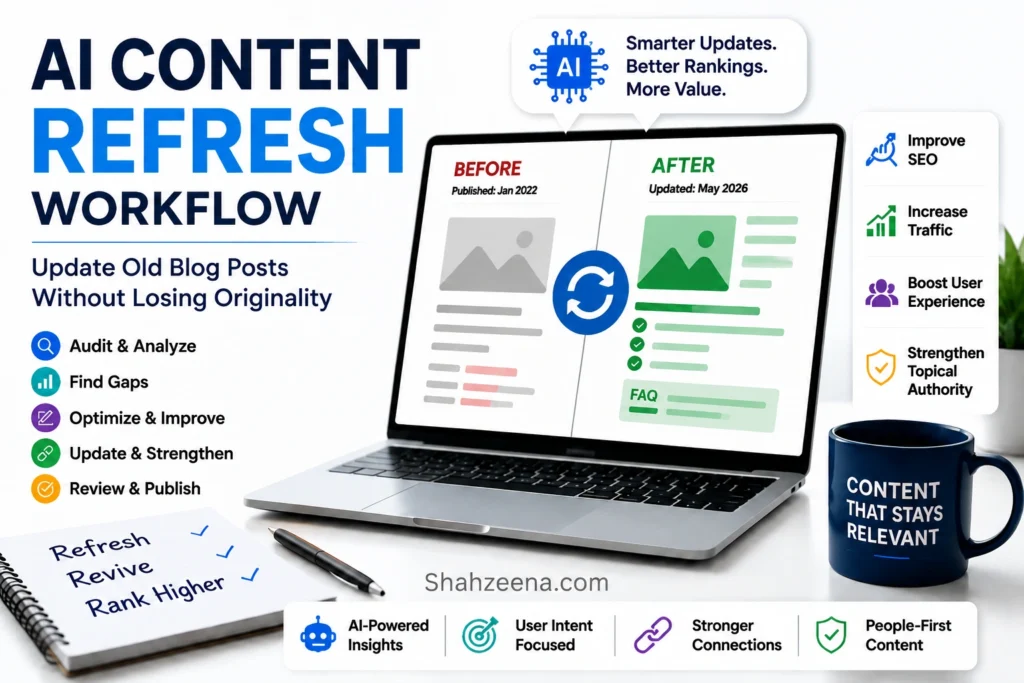
Publishing a blog post is not the end of the content journey.
Over time, even well-written articles can lose visibility because information becomes outdated, competitors publish better resources, search intent changes, or readers expect more complete answers.
This is where an AI content refresh workflow becomes valuable.
Instead of deleting old content or rewriting everything from scratch, AI can help you analyze existing articles, identify improvement opportunities, and update them while preserving the original expertise and perspective that made the content valuable.
The goal is not to create another generic AI-written article.
The goal is to make your existing content more accurate, useful, complete, and aligned with what users need today.
What Is an AI Content Refresh Workflow?
An AI content refresh workflow is a structured process where artificial intelligence tools assist in improving existing content.
The process usually includes:
- Reviewing outdated information
- Finding missing topics
- Improving article structure
- Expanding weak explanations
- Updating examples
- Optimizing SEO elements
- Improving internal linking
- Adding relevant FAQs
A content refresh is different from a complete rewrite.
A rewrite replaces the original article.
A refresh improves what already exists.
A strong refresh keeps:
- Original ideas
- Personal experience
- Unique insights
- Brand voice
While improving:
- Accuracy
- Readability
- Search coverage
- User experience
AI works best as an analytical assistant, not as a replacement for human expertise.
Why Old Blog Posts Need Regular Refreshing
Many websites focus only on publishing new articles, but existing content often has significant growth potential.
An older article may already have:
- Search visibility
- Existing backlinks
- Indexed pages
- Historical authority
Improving that article can sometimes be more efficient than creating a completely new page.
Search Intent Changes Over Time
The way people search changes.
A topic that worked two years ago may not fully answer today’s questions.
For example:
An old SEO article might focus only on keyword placement.
Modern readers may expect information about:
- Search intent
- Helpful content principles
- AI-assisted workflows
- Semantic optimization
- User experience
The topic remains similar, but expectations evolve.
Information Becomes Outdated
Many industries change quickly.
Examples:
- Software features change
- AI tools receive updates
- SEO practices evolve
- Platforms introduce new systems
A useful article today can become incomplete tomorrow if important updates are ignored.
Competitors Improve Their Content
Search results are not static.
A competitor may create a better resource by adding:
- More examples
- Better explanations
- Updated information
- Useful templates
- FAQs
A content refresh helps identify what your article is missing.
The Complete AI Content Refresh Workflow
Step 1: Identify Which Content Needs Refreshing
Before using AI, decide which articles deserve attention.
Good candidates usually include:
Articles with declining traffic
A page that once performed well but slowly lost visitors may need updates.
Possible reasons:
- Outdated information
- Better competitor content
- Changed search intent
Articles ranking near page one
Content sitting around positions 5–20 may only need improvements to compete better.
Look for:
- Missing sections
- Better examples
- Stronger explanations
- Improved internal links
Articles with outdated information
Review content that mentions:
- Old tools
- Previous features
- Expired recommendations
- Past examples
Step 2: Audit Existing Content Before Editing
Do not immediately ask AI to rewrite an article.
First understand what needs improvement.
AI can help analyze:
- Weak sections
- Missing topics
- Repetitive explanations
- Unclear paragraphs
- Potential FAQ opportunities
A useful audit asks:
- Does this article solve the user’s original problem?
- Are examples still relevant?
- Are important concepts missing?
- Is the structure easy to follow?
Step 3: Recheck Search Intent
One of the biggest content mistakes is updating information without updating purpose.
Search intent means understanding what the user actually wants.
For example:
A person searching:
“AI content refresh”
probably does not only want:
“What is AI?”
They likely want:
- How to update existing articles
- Which steps to follow
- How to avoid poor AI rewrites
- How to maintain originality
A successful refresh improves alignment with the user’s goal.
Step 4: Find Semantic Gaps and Missing Topics
Modern SEO is not only about repeating keywords.
Search engines need context.
AI can help identify related concepts such as:
- Content audit
- Internal linking
- Search intent analysis
- Keyword gaps
- User experience
- Topical authority
- Content optimization
A stronger article usually covers the complete topic ecosystem instead of one keyword.
Step 5: Improve Structure Without Destroying Original Voice
This is where many AI content updates fail.
A common mistake:
Copy the article into an AI tool and ask:
“Rewrite this better.”
The result may sound cleaner but lose the original value.
Instead, improve:
Headings
Make sections easier to scan.
Explanations
Replace vague statements with practical guidance.
Examples
Add useful situations readers can understand.
Flow
Move information into a logical order.
Keep your original:
- Experience
- Opinions
- Unique insights
Those elements create differentiation.
Step 6: Improve SEO Elements
A content refresh should include more than text changes.
Review:
Title Tag
Does it clearly explain the benefit?
Meta Description
Does it encourage the right users to click?
Headings
Do they cover important subtopics?
Internal Links
Do they guide readers to related resources?
For example, a complete SEO improvement process should connect with a structured SEO playbook that explains broader optimization methods.
Step 7: Add Human Review Before Publishing
AI can speed up analysis, but human review is essential.
Before publishing, check:
Accuracy
Are all recommendations still correct?
Originality
Does the article still represent your expertise?
Clarity
Can a beginner understand it?
Usefulness
Does it solve a real problem?
Google’s people-first approach emphasizes creating content that genuinely helps users rather than content created only to manipulate rankings.
Useful AI Prompts for Content Refresh
Content Audit Prompt
“Analyze this article and identify outdated sections, missing topics, unclear explanations, and opportunities to improve usefulness.”
SEO Gap Analysis Prompt
“Compare this article topic against current search expectations and identify important concepts, entities, and questions that are missing.”
FAQ Discovery Prompt
“Find realistic user questions related to this topic that would improve the article’s helpfulness.”
Improvement Prompt
“Suggest improvements to this article while preserving the original expertise, tone, and unique insights.”
Common AI Content Refresh Mistakes
Mistake 1: Replacing Everything With AI Text
A complete AI rewrite can remove the human perspective that made the article valuable.
Better approach:
Improve existing expertise instead of replacing it.
Mistake 2: Adding Keywords Without Improving Value
Adding more keywords does not automatically create better content.
Readers want:
- Clear answers
- Practical guidance
- Useful examples
Mistake 3: Removing Original Experience
Personal examples and lessons often create trust.
Do not remove them just because AI produces cleaner writing.
Mistake 4: Ignoring Internal Links
A refreshed article should improve website navigation.
Internal links help users discover related resources.
Mistake 5: Publishing Without Review
AI-generated suggestions still require human judgment.
Always verify important information before publishing.
AI Content Refresh vs Full Rewrite: Which Should You Choose?
| Situation | Better Option |
| Article performs well but needs updates | Content refresh |
| Article has backlinks and authority | Content refresh |
| Article has outdated sections only | Content refresh |
| Article has poor structure from the beginning | Rewrite |
| Topic has completely changed | New content strategy |
Tools That Support AI Content Refresh
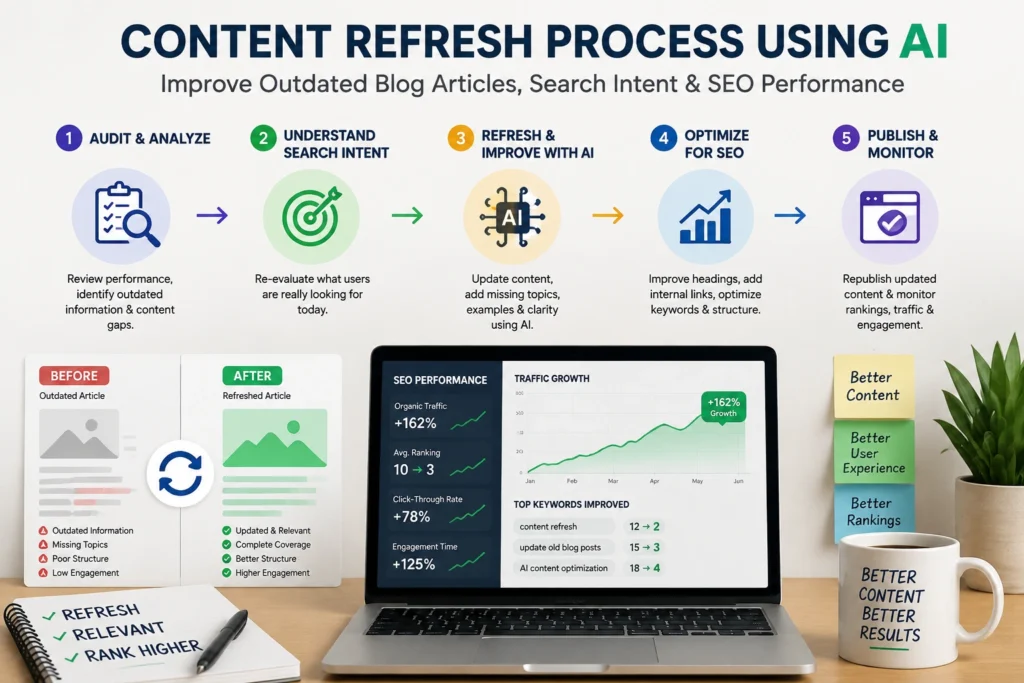
A complete workflow usually combines several categories:
AI Assistants
Useful for:
- Analysis
- Outlining
- Identifying gaps
- Improving explanations
If you experience issues while working with AI tools, this ChatGPT troubleshooting guide can help resolve common usage problems and workflow interruptions.
SEO Research Tools
Useful for:
- Keyword research
- Competitor analysis
- Search intent research
You can explore relevant SEO resources through this SEO tools hub.
Browser-Based SEO Helpers
SEO Chrome extensions can help with:
- Quick page analysis
- Metadata review
- SERP research
How AI Content Refresh Supports Modern SEO
A successful refresh improves:
User Satisfaction
Readers find more complete answers.
Content Quality
Information becomes clearer and more useful.
Topic Coverage
The article connects related concepts.
Website Authority
Updated resources support stronger topical depth.
AI helps accelerate the process, but the strategy still depends on understanding users.
Final Thoughts
AI content refresh is not about pressing a button and replacing old articles with machine-generated text.
The strongest workflow combines:
- AI analysis
- SEO research
- Human expertise
- Original insights
- Careful editing
Use AI to discover opportunities, improve structure, and identify missing information.
But keep the human perspective that makes your content worth reading.
Before creating more AI-generated drafts, improve the valuable content you already have.
Use the SEO playbook to refresh existing content with a structured SEO process before scaling new AI-generated drafts.
Frequently Asked Questions
Yes, AI can help refresh old blog posts by identifying outdated sections, missing topics, unclear explanations, and potential SEO improvements. However, human review is still important to maintain accuracy, originality, and brand voice.
Updating old content can improve SEO when the changes make the page more useful for users. Improvements may include updating outdated information, improving structure, answering missing questions, and adding relevant internal links.
Usually, no. If an article already has valuable information, rankings, or backlinks, refreshing it is often better than replacing it completely. A full rewrite is more suitable when the original content no longer matches the topic or user intent.
There is no universal schedule. Refresh frequency depends on the topic, industry changes, and how quickly information becomes outdated. Fast-changing topics may require more frequent reviews than evergreen content.
AI-assisted updates can become harmful when they remove originality, add inaccurate information, or create content only for search engines. The safest approach is using AI as a support tool while maintaining human expertise and review.