
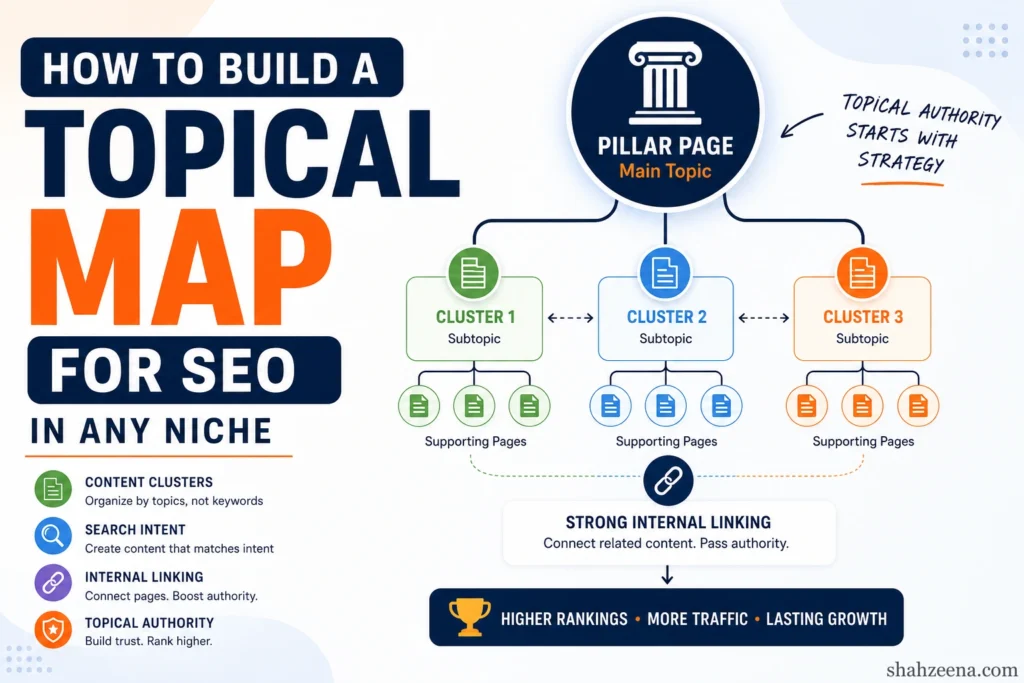
Most blogs fail to build topical authority because their content strategy is reactive instead of structured. They publish random posts, target disconnected keywords, and create pages with no semantic relationship.
A topical map solves this problem.
Instead of treating SEO as individual keyword targeting, a topical map helps you organize your content into connected topic clusters that improve relevance, crawlability, and user experience.
Whether you run a niche affiliate site, a business blog, or a content publication, building a topical map can help search engines understand your expertise more clearly.
This guide explains how to build a topical map for SEO step by step, including structure, clustering, internal linking, and common mistakes to avoid.
What Is a Topical Map in SEO?
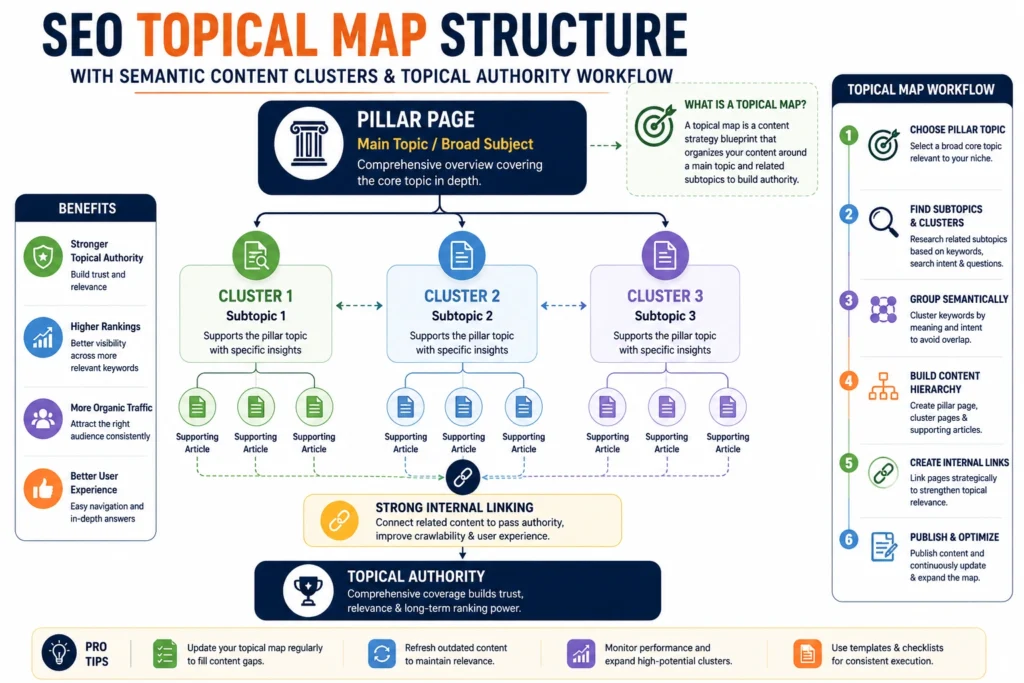
A topical map is a structured content framework that organizes topics, subtopics, and supporting pages around a central subject.
Think of it as a blueprint for topical authority.
Instead of creating isolated articles, you build connected content clusters that cover a subject comprehensively.
For example, a blog about SEO might organize content into areas like:
- Technical SEO
- Semantic SEO
- Keyword research
- Internal linking
- On-page optimization
- Topical authority
Each area then branches into supporting subtopics and related user questions.
This structure helps search engines understand:
- What your site is about
- How pages relate to each other
- Which topics do you cover deeply
- Whether your site demonstrates expertise
Why Topical Maps Matter for Modern SEO
Search engines no longer rely only on exact-match keywords. Modern ranking systems evaluate relationships between topics, entities, intent, and contextual relevance.
A topical map helps align your content with that reality.
When your content covers a topic comprehensively, your site becomes more relevant within that subject area.
Instead of publishing scattered articles, you create interconnected expertise.
Creates better internal linking
A topical map naturally supports internal links between related pages.
That improves:
- Crawl paths
- Context signals
- User navigation
- Page discovery
You can also strengthen your content planning using the SEO playbook.
Supports semantic search visibility
Semantic SEO focuses on meaning, context, and relationships between topics.
A topical map supports semantic relevance by connecting related concepts naturally instead of repeating keywords unnaturally.
Prevents random publishing
Without a structure, many blogs publish whatever topic appears trending.
A topical map creates direction and consistency so every article contributes to broader topical coverage.
Core Elements of a Strong Topical Map
A good topical map is more than a keyword spreadsheet.
It combines search intent, semantic relationships, content hierarchy, and internal linking.
Pillar topics
These are your broad core categories.
Examples:
- SEO
- Email marketing
- WordPress
- AI tools
- Affiliate marketing
Pillar topics usually support multiple cluster articles.
Supporting clusters
Cluster content expands the main topic into narrower questions and subtopics.
For example, a topical authority cluster may include:
- Topical Map Seo
- Content Clusters
- Semantic Keyword Grouping
- Internal Linking Strategy
- Entity Seo
Search intent mapping
Every topic should match a clear user goal.
Common intent types include:
- Informational
- Commercial
- Navigational
- Transactional
If intent is mixed incorrectly, rankings become unstable.
Internal link relationships
A topical map should define:
- Parent Pages
- Supporting Pages
- Related Pages
- Contextual Anchor Text
This improves content discoverability and topical flow.
Content depth and coverage
Strong topical maps answer:
- Beginner Questions
- Intermediate Problems
- Advanced Implementation Issues
- Comparison Queries
- Tool-Related Searches
How to Build a Topical Map Step by Step
Choose a Core Niche Topic
Start with one primary subject your site wants to build authority around.
Examples:
- Local SEO
- SaaS marketing
- Fitness training
- Home gardening
- AI productivity tools
Avoid selecting topics that are too broad initially.
A focused topical map is easier to build and maintain.
Identify Subtopics and Clusters
List all major subtopics connected to the core topic.
You can find ideas from:
- Google Autocomplete
- People Also Ask
- Related Searches
- Forum Discussions
- Competitor Content Gaps
- Audience Questions
The goal is not just to collect keywords.
You want connected concepts.
You can also understand how keyword relationships work in modern SEO through AI semantic keyword clustering approach, which helps in grouping related topics more effectively.
Example:
Core Topic: Semantic SEO
Related Clusters:
- Topical Maps
- Entity Seo
- Keyword Clustering
- Search Intent Analysis
- Content Hierarchy
- Internal Linking
Map Search Intent
Not all keywords serve the same purpose.
For example:
- “What Is Topical Authority” = Informational
- “Best Seo Topical Map Tools” = Commercial
- “Topical Map Template” = Solution-Focused
Grouping pages by intent helps avoid overlap and keyword cannibalization.
Group Keywords Semantically
Semantic grouping means organizing keywords by meaning and contextual relationship rather than exact wording.
Example:
Instead of separating:
- Topical Map Seo
- Seo Topical Map
- Topical Mapping For Seo
You would group them into one central content asset.
This creates stronger topical relevance and avoids duplicate intent targeting.
You can also validate content balance using the keyword frequency checker.
Build Content Hierarchy
Your hierarchy should move from broad to specific.
Example structure:
Pillar Page
Topical Authority SEO
Cluster Pages
- Topical Map Seo
- Semantic Keyword Clustering
- Entity-Based Seo
- Content Hub Strategy
Supporting Articles
- How To Audit Topical Coverage
- Common Internal Linking Mistakes
- Search Intent Examples
This structure helps search engines understand topical relationships.
Create Internal Linking Paths
Every important page should connect naturally to related articles.
Good internal linking:
- Passes Contextual Relevance
- Improves Navigation
- Distributes Authority
- Helps Crawlers Discover Pages
Avoid linking unrelated pages simply to add links.
Use descriptive anchors that match user expectations.
For example, if you are optimizing titles and snippets, the title and meta description checker.
Prioritize Publishing Order
Start with foundational pages first.
Recommended order:
- Pillar topic
- Core supporting clusters
- Supporting FAQs
- Commercial pages
- Advanced implementation guides
This creates stronger topical foundations over time.
Example of a Simple Topical Map
Imagine a blog about affiliate SEO.
Main Topic
Affiliate SEO
Cluster Topics
- Keyword Research
- Topical Authority
- Seo Content Briefs
- Topical Maps
- Affiliate Content Strategy
- Internal Linking
Supporting Articles
- How To Build Topical Clusters
- Affiliate Keyword Intent Guide
- Seo Site Structure Mistakes
- Semantic Seo Workflow
Each page supports the others through contextual linking and semantic relevance.
Common Topical Mapping Mistakes
Random articles weaken topical clarity.
If your site focuses on SEO, unrelated topics dilute relevance.
Ignoring search intent
A page targeting informational intent should not suddenly become sales-heavy.
Intent mismatch often reduces engagement and rankings.
Creating duplicate pages
Multiple pages targeting the same intent can compete against each other.
This creates keyword cannibalization problems.
Weak internal links
Many blogs create cluster content but fail to connect pages properly.
Without internal relationships, the topical structure becomes weak.
Targeting keywords without context
Modern SEO is not just about inserting keywords.
Context, relationships, and topical completeness matter more.
How Topical Maps Support Content Clusters
Content clusters become significantly stronger when they follow a topical map.
Instead of isolated articles, clusters create:
- Semantic Depth
- Better Crawl Paths
- Stronger Contextual Signals
- Improved User Journeys
This also helps future content planning because every new article fits into a structured system.
To organize your workflow faster, use the SEO templates and resources.
Use the SEO templates and resources to convert your topical map into publishable briefs.
Tools That Can Help Build a Topical Map
Useful tools may include:
- Google Search
- Google Search Console
- Keyword Clustering Tools
- Mind Mapping Tools
- Spreadsheet Systems
- Seo Crawlers
- Entity Extraction Tools
The exact tools matter less than the structure and strategic thinking behind the map.
How to Maintain and Expand Your Topical Map
A topical map should evolve as your site grows.
Review your structure periodically to:
- Identify Content Gaps
- Update Outdated Pages
- Improve Internal Links
- Expand Clusters
- Consolidate Overlapping Topics
Over time, your topical map becomes the foundation of your content ecosystem.
FAQs
A topical map is a structured framework that organizes related topics, subtopics, and supporting content around a central subject to improve topical authority and semantic relevance.
It helps search engines understand relationships between pages, improves internal linking, supports semantic relevance, and strengthens topical authority.
Keyword clustering groups related keywords, while a topical map organizes entire content relationships, hierarchy, intent, and internal linking structure.
Yes. Small blogs often benefit the most because a clear topical structure helps build authority faster within a focused niche.
There is no fixed number. The right size depends on topic depth, user intent, and competitive coverage requirements.
Final Thoughts
A topical map is not just an SEO exercise.
It is a content planning system that improves structure, clarity, and topical relevance across your website.
Instead of publishing disconnected articles, you create a semantic framework that helps both users and search engines understand your expertise.
The strongest topical maps are:
- Intentional
- Search-Intent Aligned
- Semantically Connected
- Internally Linked
- Continuously Expanded
When done correctly, they support long-term topical authority rather than short-term keyword targeting.


