
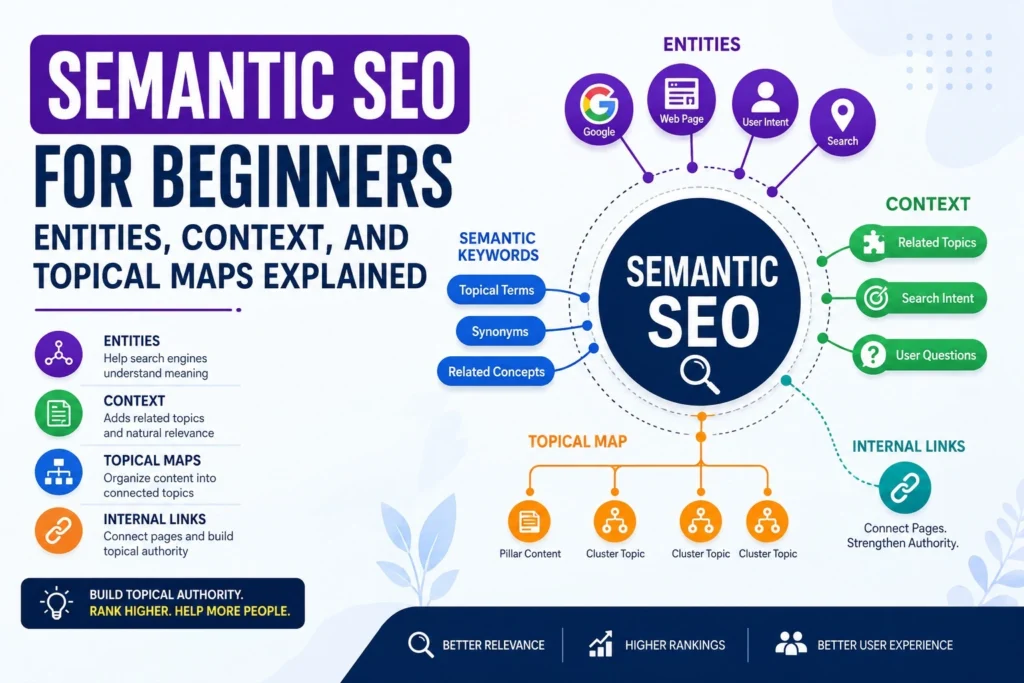
SEO is no longer only about repeating exact-match keywords.
Modern search engines try to understand meaning, relationships, context, and user intent. This shift is why semantic SEO has become an important part of content optimization.
If you are still creating content around isolated keywords without supporting context, your pages may struggle to compete against more helpful and complete content.
This guide explains semantic SEO in beginner-friendly language so you can understand how entities, semantic keywords, topical authority, and topical maps work together.
What Is Semantic SEO?
Semantic SEO is the process of creating content that helps search engines understand the meaning and context of a topic instead of focusing only on exact keywords.
Rather than writing one page around a single phrase, semantic SEO connects related ideas, concepts, entities, and questions that users naturally expect around a topic.
Semantic SEO can also be supported with modern modern AI-based workflows, where writers use structured prompting techniques to create more context-aware AI SEO workflows.
For example, a traditional SEO article about “email marketing” might only repeat that phrase many times.
A semantic SEO article would also naturally include related concepts like:
- Email campaigns
- Open rates
- Newsletters
- Automation
- Subscriber lists
- Conversion tracking
- Audience segmentation
This creates stronger topical relevance.
Google’s systems are designed to reward content that is useful, reliable, and written for people first.
Why Semantic SEO Matters in Modern Google Search
Search engines have improved significantly in understanding language and relationships between topics.
Today, Google attempts to understand:
- What a page is truly about
- What the user actually wants
- How topics connect together
- Whether the content fully answers the query
This means shallow keyword-focused content often performs worse than comprehensive, context-rich content.
Semantic SEO helps:
- Improve topical relevance
- Strengthen internal linking
- Support topical authority
- Improve user experience
- Cover related search intent naturally
If you want to build stronger SEO foundations, your content strategy should move beyond isolated keywords.
You can also learn broader SEO fundamentals in this Shahzeena.com complete SEO playbook.
Semantic SEO vs Traditional Keyword SEO
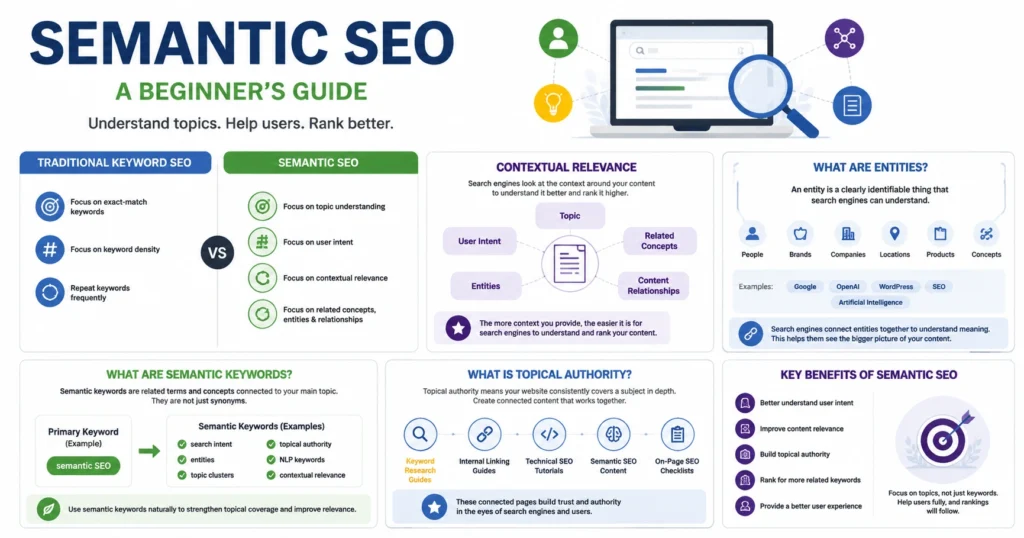
Traditional keyword SEO mainly focused on:
- Exact-match phrases
- Keyword density
- Repeating keywords frequently
Semantic SEO focuses more on:
- Topic understanding
- User intent
- Contextual relevance
- Related concepts
- Entities
- Content relationships
This does not mean keywords are unimportant.
Keywords still help search engines understand page topics. However, semantic SEO improves how naturally and completely those topics are covered.
For example:
Traditional SEO
“Best running shoes” repeated many times.
Semantic SEO
Content also discusses:
- Cushioning
- Foot support
- Trail running
- Stability
- Running comfort
- Shoe materials
- Athletic brands
This creates stronger topical depth.
What Are Entities in SEO?
An entity is a clearly identifiable thing that search engines can understand.
Entities can include:
- People
- Brands
- Companies
- Locations
- Products
- Technologies
- Concepts
Examples:
- OpenAI
- WordPress
- SEO
- Artificial intelligence
Search engines connect entities together to understand meaning.
For example, if a page discusses:
- Google Search
- Ranking systems
- Helpful content
- Search intent
Google can better understand the broader SEO topic being discussed.
Simple Entity Examples
| Topic | Possible Entities |
| SEO | Google Search Console, backlinks, keywords |
| AI | machine learning, ChatGPT, neural networks |
| Blogging | WordPress, content writing, SEO plugins |
Entities help search engines understand relationships between ideas.
What Are Semantic Keywords?
Semantic keywords are related terms and concepts connected to the main topic.
They are not simply synonyms.
For example, semantic keywords for “semantic SEO” may include:
- Search intent
- Topical authority
- Entities
- NLP keywords
- Topic clusters
- Contextual relevance
These terms help strengthen topical coverage naturally.
Primary Keywords vs Semantic Keywords
| Type | Example |
| Primary keyword | semantic SEO |
| Semantic keywords | entities SEO, topical authority, semantic content |
The goal is not to force every variation into the article.
Instead, semantic keywords should appear naturally where relevant.
What Is Topical Authority?
Topical authority means your website consistently covers a subject in depth.
Instead of publishing random disconnected articles, authoritative sites create connected topic ecosystems.
For example, an SEO website may contain:
- Keyword research guides
- Internal linking guides
- Technical SEO tutorials
- Semantic SEO content
- On-page SEO checklists
Together, these pages strengthen overall authority.
This is one reason internal linking matters so much.
Explore more SEO guides and resources.
What Is a Topical Map?
A topical map is a structured content plan that organizes related topics around a core subject.
Think of it like a knowledge map.
Example:
Main Topic
Semantic SEO
Supporting Topics
- Entities in SEO
- Topical authority
- Keyword clustering
- Search intent
- Internal linking
- Semantic content writing
This structure helps:
- Improve content organization
- Support internal linking
- Reduce content gaps
- Strengthen topical relevance
Simple Topical Map Example
| Core Topic | Supporting Topics |
| Semantic SEO | entities, search intent, NLP keywords |
| Blogging SEO | content writing, internal links, metadata |
How Internal Linking Supports Semantic SEO
Internal links help search engines understand relationships between pages.
When related articles connect together naturally, it strengthens topical understanding.
For example:
- A semantic SEO article can link to keyword research
- A topical authority article can link to internal linking strategies
- A beginner SEO guide can connect to technical SEO tutorials
Good internal linking:
- Improves crawlability
- Distributes authority
- Supports contextual relevance
- Helps users discover related content
How to Apply Semantic SEO to One Blog Post
Semantic SEO becomes easier when you use a practical workflow.
Step 1: Understand Search Intent
Ask:
- What does the user want?
- Are they learning, comparing, or buying?
For this article, users want beginner education.
Step 2: Find Related Questions
Look for:
- Google autocomplete
- Related searches
- People Also Ask questions
- Forums and communities
These reveal semantic relationships.
Step 3: Add Semantic Context
Instead of repeating one keyword endlessly:
- Explain related concepts
- Include examples
- Answer connected questions
- Use natural language
Step 4: Connect Related Content
Use internal links to connect supporting articles naturally.
You can also use tools like this keyword density checker to review keyword balance.
Common Semantic SEO Mistakes
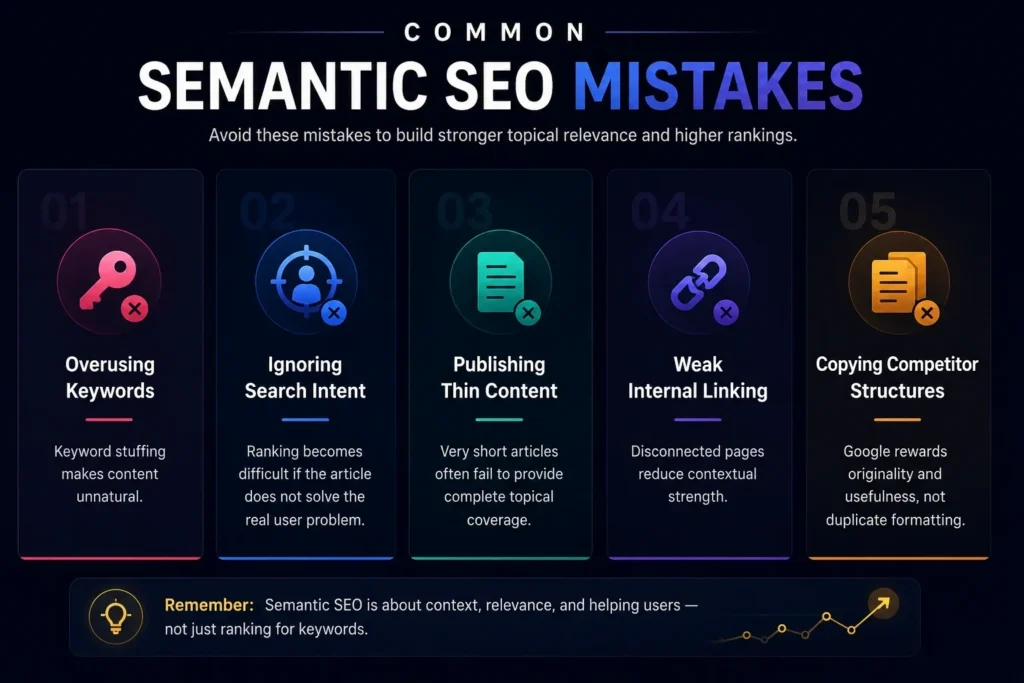
Overusing Keywords
Keyword stuffing makes content unnatural.
Ignoring Search Intent
Ranking becomes difficult if the article does not solve the real user problem.
Publishing Thin Content
Very short articles often fail to provide complete topical coverage.
Weak Internal Linking
Disconnected pages reduce contextual strength.
Copying Competitor Structures
Google rewards originality and usefulness, not duplicate formatting.
Beginner Semantic SEO Checklist
Before publishing:
- Define one primary keyword
- Identify semantic keywords
- Understand user intent
- Include related concepts
- Use descriptive headings
- Add internal links
- Answer real questions
- Improve readability
- Avoid keyword stuffing
- Add useful examples
Use the free SEO tools and resources to apply semantic SEO checks to your own content.
FAQs Semantic SEO
Semantic SEO means creating content that helps search engines understand meaning and context rather than focusing only on repeating exact keywords.
No. Semantic keywords are related concepts and contextual terms connected to the main topic.
Entities help search engines understand relationships between topics, brands, people, products, and concepts.
Topical authority means covering a subject deeply and consistently across multiple connected pages.
Yes. Even beginner blogs benefit from better structure, related topics, internal linking, and stronger search intent alignment.


