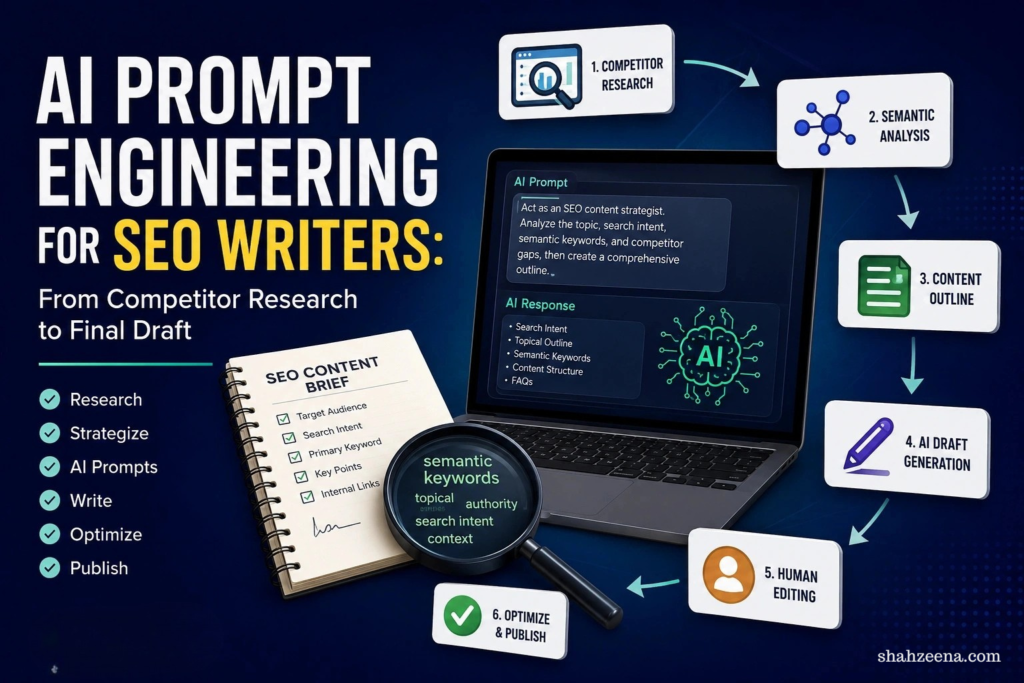
AI tools changed how SEO content is produced, but many websites still publish weak AI-generated articles that fail to rank or help users.
The problem is usually not the AI tool itself. The real issue is the workflow behind it.
Many writers open an AI assistant, type “write an SEO article,” and expect publish-ready content. That approach often creates generic articles with weak topical coverage, shallow search intent alignment, repetitive wording, and poor originality.
Professional SEO writers use AI differently.
They use structured prompt engineering workflows that combine competitor research, semantic analysis, search intent understanding, editorial constraints, and human review.
This article explains how to build that workflow from research to final draft.
Why Most AI SEO Content Fails
Low-quality AI content usually shares the same problems:
- Weak understanding of search intent
- Repetitive keyword usage
- No topical depth
- Missing semantic relationships
- Generic introductions
- Copied SERP structures
- Poor internal linking
- Factual uncertainty
- No editorial review
Search engines increasingly evaluate usefulness, originality, topical completeness, and user satisfaction rather than simply detecting keywords.
That means SEO writers need systems, not shortcuts.
What Is Prompt Engineering in SEO?
Prompt engineering in SEO means designing structured instructions that help AI produce useful, controlled, and context-aware outputs.
A strong SEO prompt does more than request an article.
It gives the AI:
- A role
- A target audience
- Search intent
- Semantic context
- Formatting rules
- Quality constraints
- Topical direction
- Editorial goals
The difference between weak prompting and strategic prompting is massive.
Prompting vs Strategic Workflows
Weak prompt:
“Write a blog post about AI SEO prompts.”
Strategic workflow prompt:
“Act as a semantic SEO strategist and content editor. Analyze search intent, identify NLP entities, avoid copying competitor structures, and generate a people-first article outline for intermediate SEO writers.”
The second prompt creates structure, context, and quality expectations.
Why Context Matters More Than Word Count
AI performs better when it receives layered context.
Good SEO workflows include:
- Competitor insights
- Target keywords
- Semantic phrases
- Internal links
- Audience awareness
- Topical relationships
- Publishing goals
Without context, AI fills gaps with generic assumptions.
The Research-First AI SEO Workflow
The strongest AI-assisted SEO systems begin with research before drafting.
Step 1: Understand Search Intent
Before generating content, identify what users actually want.
For example, someone searching for “AI prompts for SEO” may want:
- Workflow systems
- Practical prompt examples
- Semantic SEO guidance
- Content optimization methods
- AI-assisted research techniques
Intent defines structure.
If the article misses intent, rankings become unstable even if keywords are present.
Step 2: Analyze SERP Patterns
Study top-ranking pages carefully.
Look for:
- Recurring subtopics
- Missing content gaps
- Weak explanations
- Outdated sections
- Overused structures
- Unanswered questions
The goal is not to copy competitors.
The goal is to understand what search engines already associate with the topic and then create something more useful.
Step 3: Extract Semantic Keywords and Entities
Modern SEO relies heavily on contextual relevance.
Instead of repeating one keyword excessively, identify related entities and concepts such as:
- Semantic SEO
- Topical authority
- Search intent
- NLP entities
- Internal linking
- Structured workflows
- Content optimization
- Prompt frameworks
These relationships strengthen topical depth naturally.
If you want a structured optimization process, explore the complete SEO playbook at
complete SEO playbook
Step 4: Build a Topical Content Outline
After semantic analysis, create a structured outline.
A strong outline should:
- Satisfy search intent
- Cover beginner and intermediate questions
- Include semantic relationships
- Organize ideas logically
- Support internal linking opportunities
This stage often determines whether the final article feels comprehensive or fragmented.
A strong topical content outline is based on semantic SEO structure, which ensures better organization, intent coverage, and internal linking strategy within a topical SEO framework.
Step 5: Generate First-Draft Sections Carefully
AI works best section by section.
Instead of asking for a full article immediately, experienced SEO writers generate:
- Introductions
- Frameworks
- Comparisons
- FAQs
- Summaries
- Examples
in controlled stages.
This improves consistency and reduces hallucinations.
Step 6: Human Editing and Factual Review
Human review remains essential.
Editors should verify:
- Factual accuracy
- Readability
- Topical completeness
- Originality
- Internal links
- Search intent alignment
- Unnecessary repetition
AI speeds up workflows. Human expertise improves trust and usefulness.
You can also explore more practical AI workflows here:
AI guides
How SEO Writers Should Structure AI Prompts
Good prompt engineering usually includes four major layers.
Role-Based Prompting
Assign a clear role.
Examples:
- Semantic SEO strategist
- Technical SEO editor
- Topical authority specialist
- Content optimization consultant
Role assignment improves output consistency.
Context Stacking
Provide layered information gradually:
- Primary keyword
- Audience
- Search intent
- Semantic phrases
- Competitor gaps
- Required internal links
- CTA goals
This prevents generic responses.
Constraint Prompting
Constraints improve quality control.
Useful constraints include:
- Avoid keyword stuffing
- Avoid unsupported claims
- Do not copy competitor structure
- Prioritize people-first writing
- Maintain semantic relevance
Constraints help shape safer and more original content.
Output Formatting Prompts
Formatting prompts improve editorial usability.
Examples:
- “Return FAQ schema.”
- “Create H2/H3 hierarchy.”
- “List semantic entities.”
- “Generate internal link opportunities.”
This turns AI into a structured workflow assistant instead of only a writing tool.
Examples of Useful AI Prompts for SEO Writers
Below are examples of practical prompts used in modern SEO workflows.
Competitor Analysis Prompt
Analyze the top-ranking pages for the keyword “AI prompts for SEO.” Identify recurring subtopics, weak content gaps, missing semantic entities, and opportunities for better topical coverage without copying competitor structure.
Semantic Keyword Extraction Prompt
Extract NLP-relevant entities, semantic keywords, topical relationships, and contextual phrases related to AI-assisted SEO writing.
Content Outline Prompt
Create a people-first SEO article outline for intermediate SEO writers. Include semantic SEO concepts, practical workflows, FAQs, internal linking opportunities, and editorial review steps.
FAQ Generation Prompt
Generate realistic People Also Ask style questions related to AI prompt engineering for SEO writers. Avoid duplicate or low-value FAQs.
Internal Linking Prompt
Suggest relevant internal linking opportunities using only approved Shahzeena.com URLs and natural anchor text variations.
Common AI SEO Mistakes
AI can improve productivity, but poor workflows create serious SEO issues.
Publishing AI Drafts Without Editing
Unreviewed AI content often contains:
- Weak explanations
- Repetitive wording
- Vague claims
- Factual uncertainty
Human review remains necessary.
Ignoring Search Intent
Keyword usage alone is not enough.
If the article does not satisfy user intent, rankings often decline over time.
Keyword Stuffing
Overusing exact-match phrases reduces readability and topical quality.
Semantic coverage matters more than repetition.
Copying Competitor Structure
Many AI-generated articles imitate existing SERPs too closely.
This weakens originality.
Search engines increasingly reward unique usefulness rather than cloned formatting.
Weak Entity Coverage
Articles without strong entity relationships often feel shallow.
Contextual completeness improves topical authority.
To understand how AI should support expertise rather than replace it, read:
AI and human expertise
How AI and Human Expertise Work Together
The best SEO content workflows combine:
| AI Strengths | Human Strengths |
| speed | judgment |
| summarization | experience |
| structure generation | originality |
| semantic extraction | editorial quality |
| workflow automation | factual review |
AI should support decision-making, not replace expertise entirely.
A Practical AI Workflow for Semantic SEO
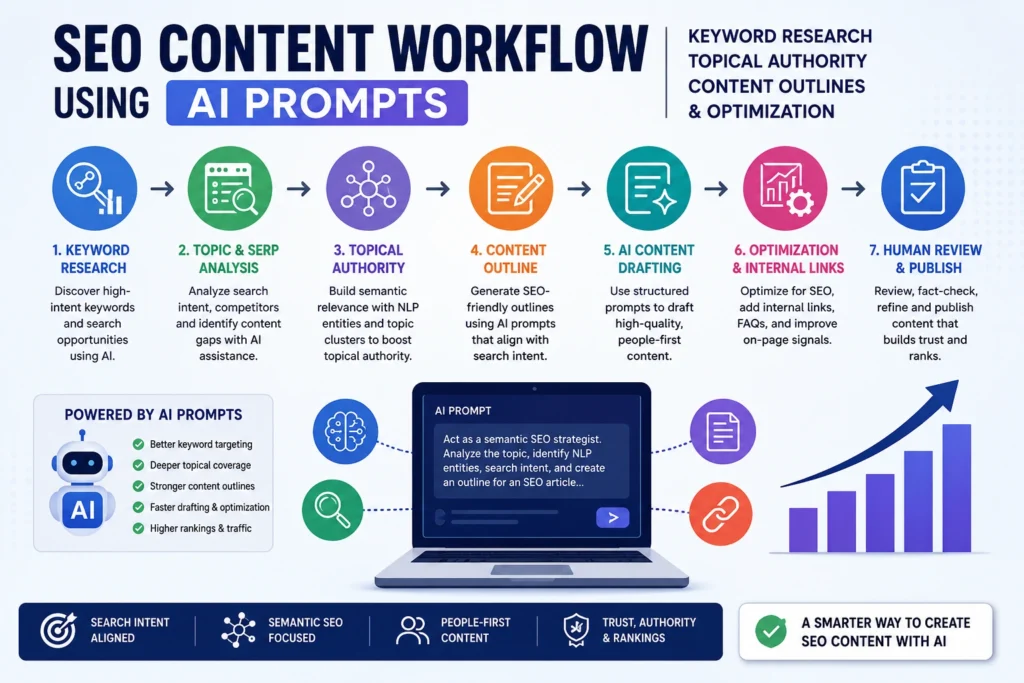
A practical workflow may look like this:
- keyword research
- SERP analysis
- Semantic extraction
- Topical mapping
- Outline generation
- Section drafting
- Internal link planning
- Editorial review
- fact verification
- optimization and publishing
This process creates more controlled and scalable SEO content systems.
You can use these SEO tools and resources to build a repeatable publishing workflow:
SEO tools and resources
Checklist Before Publishing AI-Assisted SEO Content
Before publishing, verify:
- Search intent is fully satisfied
- Headings are useful and logical
- Semantic coverage feels natural
- Internal links are relevant
- AI repetition is removed
- Claims are reviewed
- FAQs add value
- Readability is strong
- CTA placement feels helpful
- Content demonstrates originality
FAQs
AI prompts for SEO are structured instructions used to guide AI tools for keyword research, semantic analysis, content outlining, optimization, internal linking, and article drafting.
Prompt engineering improves output quality by adding context, constraints, audience targeting, and semantic direction instead of relying on generic AI requests.
AI-assisted content can rank if it is original, useful, accurate, people-first, and properly reviewed by humans.
Publishing unedited AI drafts is one of the biggest mistakes because it often creates shallow, repetitive, or inaccurate content.
Yes. Human editing improves factual accuracy, readability, originality, and search intent alignment.
Semantic SEO helps AI prompts generate broader topical relevance by including entities, contextual phrases, search intent signals, and related concepts.
Final Thoughts
AI prompt engineering for SEO is not about generating instant articles with one command.
It is about building structured workflows that improve research, semantic relevance, topical completeness, and editorial efficiency. The strongest SEO writers use AI as a strategic assistant inside a controlled publishing system.
When prompts include context, constraints, semantic direction, and human review, AI becomes far more useful for long-term SEO performance.