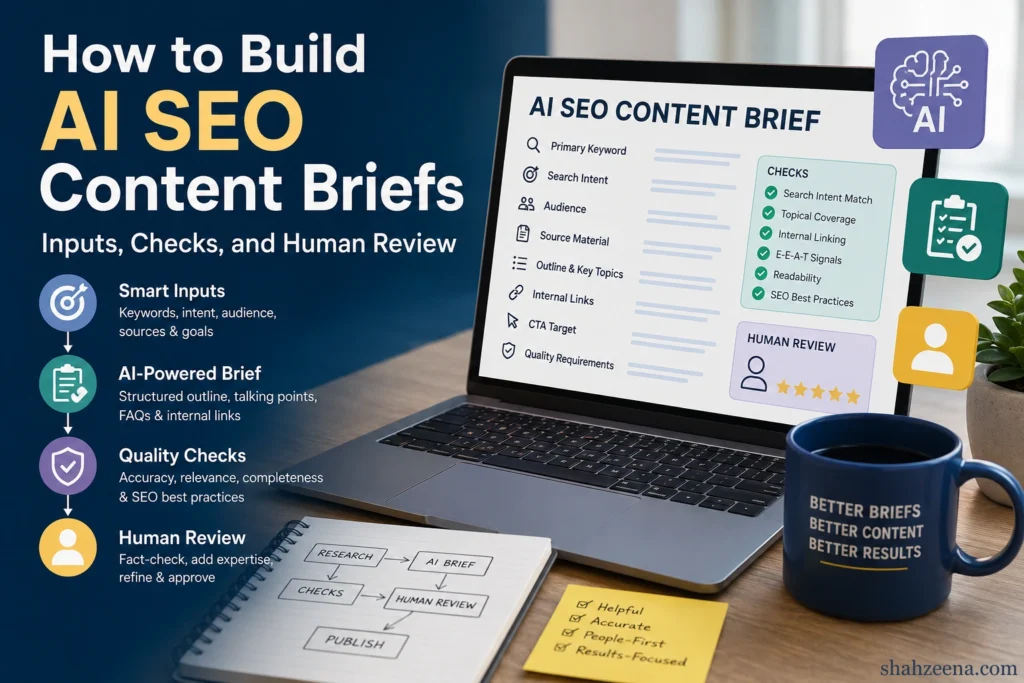
Creating content with AI has become easier than ever. Creating useful content that ranks, satisfies users, and supports business goals is still much harder.
That difference is why a strong AI SEO content brief matters.
A content brief acts as the blueprint for an article. It tells writers, editors, and AI systems what to create, why it matters, who it serves, and how success should be measured.
Without a structured brief, AI often produces content that is generic, repetitive, or disconnected from business objectives.
This guide explains how to build an AI SEO content brief using clear inputs, quality checks, and human review processes.
Why AI Content Briefs Matter
AI can generate outlines, suggest topics, organize information, and speed up content planning. However, AI only works as well as the instructions it receives.
A strong brief helps:
- Align content with search intent
- Maintain content quality
- Improve consistency
- Support topical authority
- Reduce editing time
- Strengthen internal linking
- Keep content aligned with brand goals
The goal is not to replace human expertise. The goal is to make expertise more efficient.
What an AI SEO Content Brief Should Include
Every AI-generated content project should begin with a structured brief.
At minimum, include:
Primary Keyword
The main topic the page should focus on.
Search Intent
Identify whether users are seeking information, comparisons, solutions, or transactions.
Target Audience
Define exactly who the content serves.
Examples include:
- SEO professionals
- Freelancers
- Agency teams
- Business owners
- Marketing interns
Source Material
Provide trusted resources that AI can reference when generating content.
Internal Links
Specify pages that should be connected naturally within the article.
For example, readers building larger SEO systems may benefit from learning how a complete SEO strategy works through an SEO playbook.
CTA Target
Define the desired next action before content creation begins.
Quality Standards
Establish requirements for:
- Originality
- Accuracy
- Clarity
- Structure
- Readability
- Human review
Inputs Needed Before Using AI
Many content teams rush directly into prompting.
Instead, collect inputs first.
Keyword Research
Identify:
- Primary keyword
- Supporting keywords
- Related topics
- Search intent patterns
Competitor Research
Review top-ranking pages to understand:
- User expectations
- Common questions
- Topic depth
- Content gaps
Existing Content Inventory
Check what content already exists on your site.
This prevents duplication and creates opportunities for stronger internal linking.
Brand Requirements
Include:
- Tone of voice
- Editorial standards
- Target audience
- Compliance requirements
Building an AI SEO Content Brief Step by Step
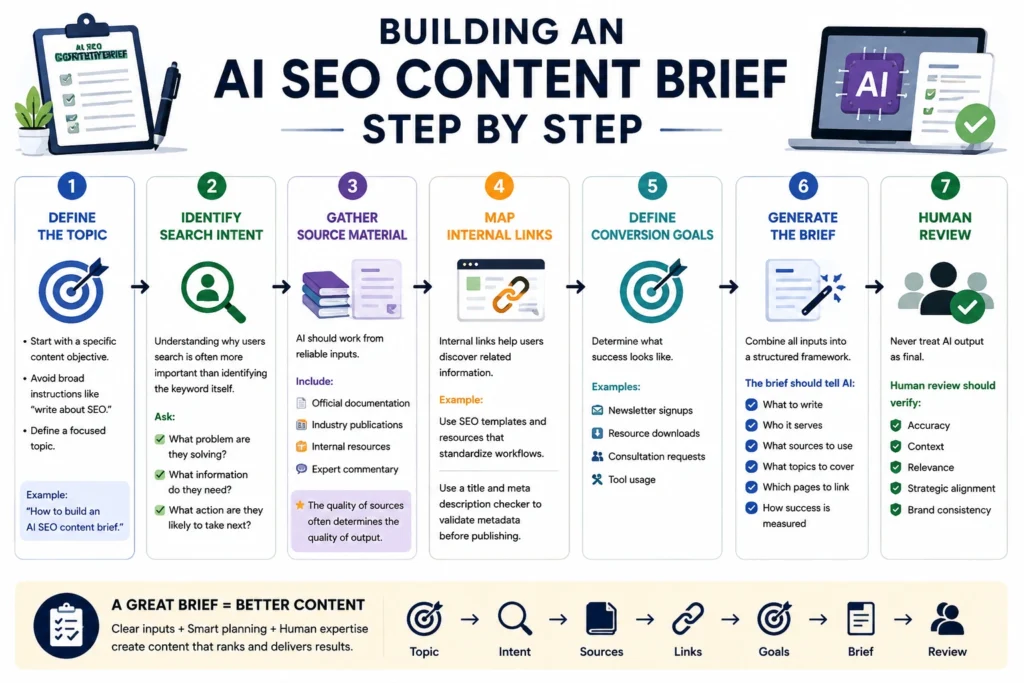
Step 1: Define the Topic
Start with a specific content objective.
Avoid broad instructions such as “write about SEO.”
Instead, define a focused topic such as:
“How to build an AI SEO content brief.”
Step 2: Identify Search Intent
Understanding why users search is often more important than identifying the keyword itself.
Ask:
- What problem are they solving?
- What information do they need?
- What action are they likely to take next?
Step 3: Gather Source Material
AI should work from reliable inputs.
Include:
- Official documentation
- Industry publications
- Internal resources
- Expert commentary
The quality of sources often determines the quality of output.
Step 4: Map Internal Links
Internal links help users discover related information.
For example, organizations building repeatable content systems may benefit from documented SEO templates and resources that standardize workflows.
Similarly, teams creating content titles can use a title and meta description checker to validate metadata before publishing.
Step 5: Define Conversion Goals
Determine what success looks like.
Examples:
- Newsletter signups
- Resource downloads
- Consultation requests
- Tool usage
Step 6: Generate the Brief
Combine all inputs into a structured framework.
The brief should tell AI:
- What to write
- Who it serves
- What sources to use
- What topics to cover
- Which pages to link
- How success is measured
Step 7: Human Review
Never treat AI output as final.
Human review should verify:
- Accuracy
- Context
- Relevance
- Strategic alignment
- Brand consistency
Common Mistakes When Using AI for Content Briefs
Missing Source Validation
AI can summarize information but should not be trusted as the sole source of facts.
Weak Internal Linking
Many AI-generated briefs ignore site architecture and content relationships.
Keyword Stuffing
Repeating keywords excessively creates poor user experiences.
Ignoring Search Intent
Ranking becomes difficult when content does not solve the user’s actual problem.
Skipping Human Review
The fastest way to create low-quality content is to publish AI output without editorial oversight.
AI Content Brief Quality Checklist
Before approving a brief, confirm:
- Primary keyword defined
- Search intent identified
- Audience specified
- Source material included
- Internal links mapped
- CTA selected
- Quality standards documented
- Competitor gaps identified
- Human review assigned
Example AI SEO Content Brief Structure
- Topic
- Primary keyword
- Search intent
- Audience
- Source materials
- Secondary keywords
- Internal links
- CTA target
- Content outline
- Editorial notes
- Review checklist
Human Review: The Most Important Step
AI can accelerate content planning, but it cannot fully replace editorial judgment.
Experienced reviewers provide:
- Strategic thinking
- Context awareness
- Brand understanding
- Fact verification
- Audience empathy
This becomes even more important when discussing complex SEO topics.
Organizations seeking sustainable results should combine automation with human expertise in AI content rather than relying entirely on generated output.
Conclusion
An AI SEO content brief is not simply a prompt. It is a planning framework that connects keyword research, search intent, source validation, internal linking, quality control, and business objectives.
The better the brief, the better the content process becomes.
Teams that invest time in structured inputs, quality checks, and human review are far more likely to produce content that is useful, trustworthy, and aligned with long-term SEO goals.
FAQs
An AI SEO content brief is a structured document that provides instructions, keywords, audience information, source material, internal links, and quality requirements for AI-assisted content creation.
AI can help generate content briefs, but human review is still necessary to validate strategy, search intent, and factual accuracy.
Human reviewers ensure accuracy, context, brand alignment, and quality standards before publication.
A strong content brief includes keywords, audience details, search intent, source material, internal links, conversion goals, and editorial requirements.
Content briefs improve consistency and help content align more closely with user needs, search intent, and business objectives.