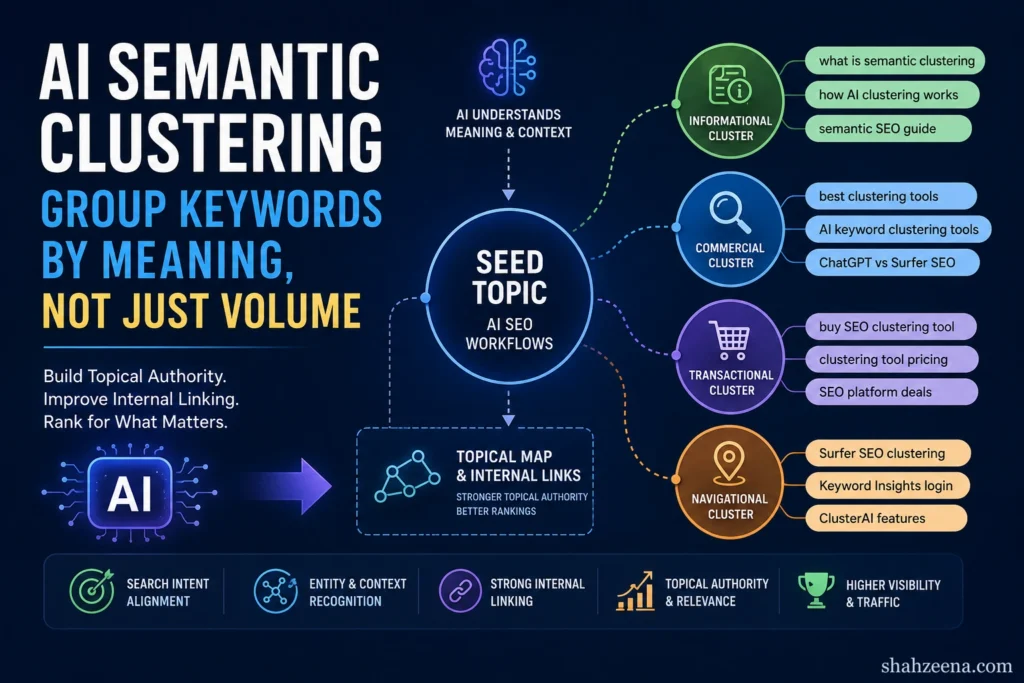
Traditional keyword grouping methods were built around search volume, exact-match phrases, and spreadsheet sorting. That approach worked when search engines relied heavily on keyword repetition.
Modern SEO works differently.
Search engines now evaluate context, entities, relationships between topics, and search intent. This is why AI keyword clustering has become one of the most valuable SEO workflows for content planning and topical authority building.
Instead of grouping keywords only because they contain similar words, semantic clustering organizes keywords based on meaning.
That shift changes how websites build content hubs, internal links, and scalable SEO strategies.
Why Traditional Keyword Grouping No Longer Works Well
Older keyword clustering methods often grouped phrases like this:
- Best Seo Tools
- Seo Tools Best
- Tools For Seo
Those keywords look similar, but that does not automatically mean they deserve the same page.
Modern search engines analyze:
- User Intent
- Semantic Relationships
- Contextual Meaning
- Topical Depth
- Entities Connected To The Query
A keyword with similar wording can still represent a completely different search expectation.
The problem with volume-only clustering
Many SEO workflows still organize keywords only by:
- Search Volume
- Keyword Difficulty
- Exact-Match Phrasing
This creates several problems:
- Thin Content
- Keyword Cannibalization
- Weak Topical Coverage
- Disconnected Internal Links
- Poor User Satisfaction
A page optimized only around repeated keyword variations often lacks real topical depth.
How search intent changed modern SEO
Search intent matters more than keyword similarity.
For example:
- “Best Ai Seo Tools”
- “How Ai Clustering Works”
- “Ai Keyword Clustering Tutorial”
These phrases all relate to AI and SEO, but users want different outcomes.
One user wants software comparisons.
Another wants educational guidance.
Another wants implementation steps.
Semantic clustering helps separate those intents correctly.
What Is AI Keyword Clustering?
AI keyword clustering is the process of grouping keywords based on semantic meaning, contextual relevance, entities, and search intent rather than exact wording alone.
AI systems use natural language processing to identify relationships between terms.
For example:
- Semantic Seo
- Topical Authority
- Entity Seo
- Nlp Optimization
These terms belong to closely related topical ecosystems even when they are not identical phrases.
Semantic relationships vs exact-match keywords
Traditional grouping asks:
“Do these keywords contain similar words?”
Semantic clustering asks:
“Would the same page genuinely satisfy these searches?”
That difference is critical.
How AI understands contextual meaning
AI clustering tools evaluate:
- Search Intent Similarity
- Entity Overlap
- Contextual Relevance
- Serp Similarity
- Topical Relationships
- Nlp Associations
This produces more accurate content planning structures.
How Semantic Clustering Works
AI semantic clustering combines multiple SEO signals.
Entity recognition
Entities are identifiable concepts connected to a topic.
For semantic SEO, entities may include:
- Google Search
- Nlp
- Topical Authority
- Internal Linking
- Search Intent
- Embeddings
- Semantic Relevance
Strong semantic clusters naturally include connected entities.
Search intent grouping
Intent clustering separates users based on goals.
Common SEO intent groups include:
- Informational
- Commercial
- Transactional
- Navigational
Mixing incompatible intents on one page weakens ranking potential.
NLP and contextual analysis
Natural language processing helps AI detect contextual similarity between phrases.
For example:
- Content Hubs
- Topical Maps
- Content Clusters
These phrases belong to overlapping semantic relationships.
Topic hierarchy building
Semantic clustering also builds parent-child relationships between topics.
Example:
Parent topic:
- AI SEO workflows
Subtopics:
- Semantic Clustering
- Keyword Extraction
- Topical Mapping
- Entity Optimization
- Internal Linking
This creates stronger site architecture.
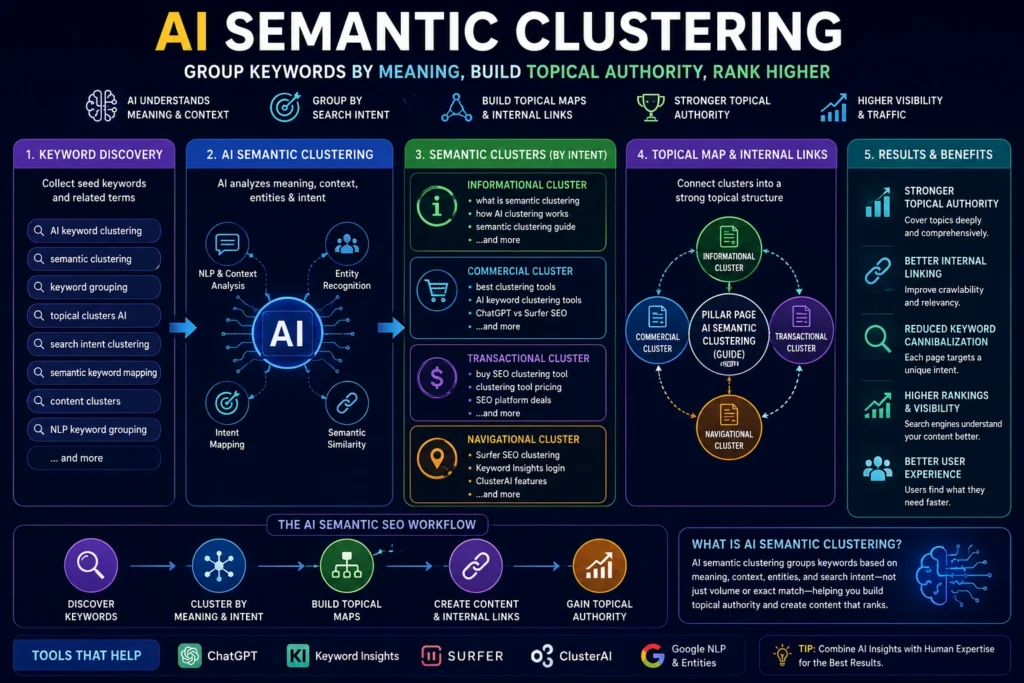
Types of Keyword Clusters in SEO
Informational clusters
Users want education or explanations.
Examples:
- What Is Semantic Clustering
- How Ai Keyword Clustering Works
- Semantic Seo Guide
Commercial investigation clusters
Users compare solutions before deciding.
Examples:
- Best Keyword Clustering Tools
- ChatGPT Vs Surfer Seo Clustering
- Ai Clustering Software Review
Transactional clusters
Users are ready to take action.
Examples:
- Buy Seo Clustering Software
- Seo Automation Platform Pricing
Users want a specific platform or brand.
Examples:
- Surfer Seo Keyword Clustering
- Keyword Insights Login
How to Build AI Semantic Clusters Step by Step
Step 1: Collect seed keywords
Start with broad topical phrases.
Examples:
- Ai Keyword Clustering
- Semantic Seo
- Topical Authority
- Nlp Seo
Use:
- Google Autocomplete
- People Also Ask
- Forums
- Seo Tools
- Search Console Data
Look for:
- Related Entities
- Contextual Phrases
- Intent Variations
- Topical Modifiers
Avoid collecting random keyword variations without context.
Step 3: Group by intent and meaning
This is where semantic clustering becomes useful.
Instead of merging everything into one spreadsheet category, organize by:
- User Goal
- Serp Similarity
- Topical Depth
- Entity Overlap
Step 4: Build topical maps
Clusters should connect naturally into broader topical ecosystems.
For example:
Main topic:
- Semantic SEO
Supporting pages:
- Ai Clustering
- Entity Seo
- Internal Linking
- Nlp Optimization
- Topical Authority
This improves topical relevance.
Step 5: Connect clusters with internal links
Internal links help search engines understand topical relationships between pages.
A strong cluster structure should support contextual linking between related pages.
You can also use the SEO topical authority guide to turn semantic clusters into full topical maps.
Example of AI Semantic Clustering
Poor keyword grouping example
One page targeting:
- Ai Seo
- Ai Tools
- Semantic Seo
- Keyword Research
- Backlink Tools
- Content Writing Ai
This creates topical confusion.
Improved semantic clustering example
Parent page:
- Ai Seo Workflows
Subpages:
- Ai Keyword Extraction
- Semantic Clustering
- Ai Internal Linking
- Entity Seo
- Topical Authority Systems
This structure improves clarity and topical depth.
Common Mistakes in AI Keyword Clustering
Do not merge informational and transactional keywords without a clear reason.
Ignoring entity relationships
A topic without connected semantic entities often feels shallow.
Creating thin pages
Publishing dozens of weak cluster pages reduces topical quality.
Using AI without manual validation
AI suggestions still require human review.
Always validate:
- Intent Alignment
- Serp Overlap
- User Expectations
- Topical Usefulness
How Semantic Clustering Supports Topical Authority
Semantic clustering strengthens SEO beyond keyword organization.
Topical depth
Clusters allow broader coverage of related concepts.
This structure becomes more effective when aligned with a proper topical content mapping framework for SEO strategy, which organizes clusters into a complete site architecture.
Internal link structure
Connected clusters naturally improve internal linking opportunities.
Useful supporting resources include:
Better crawl understanding
Search engines can better interpret content relationships.
Reduced keyword cannibalization
Semantic planning reduces overlap between pages targeting similar terms.
Best AI Tools for Semantic Keyword Clustering
ChatGPT
Useful for:
- Semantic Expansion
- Entity Extraction
- Topical Grouping
- Content Ideation
Keyword Insights
Designed specifically for keyword clustering and topical planning.
Surfer SEO
Helpful for NLP coverage and SERP-based optimization.
ClusterAI
Focused on automated keyword organization.
Manual spreadsheet workflows
Human-reviewed workflows still matter for accuracy and editorial judgment.
When to Create Separate Pages vs Merge Keywords
Create separate pages when:
- Search Intent Differs
- Serps Differ Significantly
- Users Expect Different Outcomes
Merge keywords when:
- Intent Overlap Is Strong
- The Same Page Can Satisfy Multiple Searches Naturally
- Entities And Context Strongly Align
This balance helps prevent cannibalization.
AI Semantic Clustering Workflow for Shahzeena-Style SEO
A scalable semantic workflow usually looks like this:
- Extract Seed Topics
- Expand Entities And Related Concepts
- Group By Intent
- Build Topical Maps
- Plan Internal Links
- Create Supporting Content
- Improve Contextual Authority
If you are building larger SEO ecosystems, the AI guides section can help organize AI-assisted SEO workflows more efficiently.
FAQs
AI keyword clustering is the process of grouping keywords based on semantic meaning, contextual relevance, and search intent instead of only matching similar words.
Semantic clustering helps build topical authority, improve internal linking, reduce keyword cannibalization, and create more useful content structures.
Traditional keyword grouping relies heavily on exact-match phrases, while semantic clustering organizes keywords by meaning and user intent.
Yes. AI tools like ChatGPT can help identify semantic relationships, related entities, topical gaps, and contextual keyword groupings.
Yes. Strong semantic clusters improve content relationships, topical depth, and internal linking structures that support topical authority strategies.
Final Thoughts
AI semantic clustering is no longer just an advanced SEO tactic.
It is becoming part of modern content architecture.
Search engines increasingly evaluate:
- Contextual Relationships
- Entity Coverage
- Topical Completeness
- Internal Relevance
- User Satisfaction
Grouping keywords by meaning instead of isolated volume metrics creates stronger content systems, cleaner topical maps, and more scalable SEO growth.
The goal is not simply to organize keywords.
The goal is to build content ecosystems that genuinely satisfy search intent.